Engraving a Sigh

Checking in from the field with the Taj, Tipu, Tigers, Toth, Tania, Tolkien, and the Tale.
Were an artist to choose me for his model –
How could he draw the form of a sigh?
(Zeb-un-Nissa, as referenced in Loot, by Tania James)

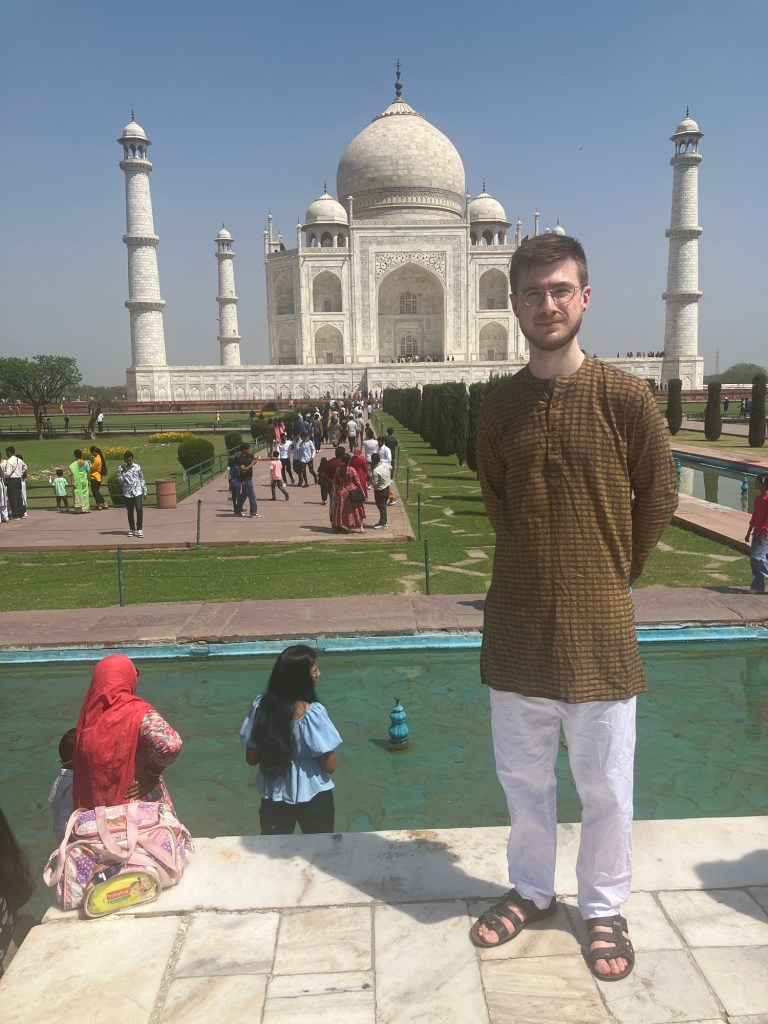
“Before she died, the empress asked her husband, Emperor Shah Jahan, to promise her four things.”

I waggled my head instinctively and said “mhmm.” Even this slight movement caused a bead of sweat to trickle down my face in the 100+ degree heat.

“One, take good care of our children. Two, remarry. Three, visit my resting place once every year. And four: for my final resting place, build a monument to our love that will last forever.”

Being a good local guide, he stopped walking at this point and allowed my companion and me to gaze up at the Taj Mahal, white marble radiant in the sun, to show that we appreciated the gravity of these words. I did. And, because I’m that type of tourist and that kind of romantic dork, I said, “He kept his promise. At least on that last one.”

“It is said he kept all four,” said our guide with a smile, and we continued on.

I wasn’t being glib. The words of the 17th Century Mughal emperor were inlaid in my mind like carnelian and emerald as we beheld this testament to their love and legacy. Here I was, hundreds of years later, awestruck, moved, just as she would have wanted.

The most beautiful sights that trip were still to come in the hill stations of Munnar, but the Taj is the place I have thought of most. When you are open to such things, sometimes a particular experience can unlock for you a new understanding of yourself, the world, and your place in it. I’ve been turning over my experience at the Taj since my visit and put it in conversation with what I’ve been reading and watching to understand something about what I’m writing. Not what I’m writing now, as in literally this sentence in this blog (though maybe this too), but what I’ve been writing – or, more often, not writing – over the last year and change, the thing I’ve been punching into my father’s Hermes just a few feet away from me.

In the presence of the Taj, quite possibly the most perfect building I have ever seen, I felt the longing a temporary being (“a mist that is here and then vanishes,” according to the Book of James) has for something resembling permanence. Not for me – I’ve got maybe 60 years left if I quit smoking and survive my family’s tragically early demises – but for my legacy, “what’s left of you when you’re gone,” as Tywin Lannister defines it. The opportunity of leaving something behind that lasts. And an opportunity is really all I’m yearning for, just the long shot possibility that something I write will last beyond me.

It’s an inspirational force. An exciting challenge. And a devastating burden.

Standing there in my sweaty kurta, squinting against the dazzling stones, thinking of monuments and legacy, of memory and stories, of love and death, of time and space, maybe the opportunity was already gone.

Microsoft recently published a study ranking, among other things, the ten jobs most threatened by Artificial Intelligence. Fifth on the list was “writers and authors.” Sad findings, but old news; at this point, anyone in creative spaces who thinks AI can’t replace them is kidding themselves. Every art form will, in the near future, be passably imitated by machines, and unless we reject AI art with all the hate in our heart, it is going to be forced on us by wealthy technocrats who don’t care at all about the actual art being produced.

If (when) the day comes that AI art is a socially-accepted fact of life, I’ll still write. The monetization of hobbies has made it difficult to remember that humans are meant to do things like sing, dance, paint, play, and tell stories even if they’re not getting paid to do so. Until the day I die, I will be writing things down, even if there are no longer people who want to read it. But, alas, I’ve gone and shared my writing too many times not to be addicted to the feeling. Every time someone reads one of my blogs or novels, I drink from the cup of embarrassment and apprehension, but the finish is rich in gratification, in affirmation, in exhilaration, and each drink only deepens the thirst. I can’t get enough, and at least for now the idea of no longer sharing my writing with others scares the shit out of me. I’ve long given up the dream of being a full-time writer, but not even being able to try, to, again, not even have the opportunity…that is a horrible outcome to ponder.

It’s not exactly a secret, but this serves as the official announcement: I’m writing a sequel to The Hunter’s Tale. It’s called Lives We Might Have Lived and is due out 2026 if I can bring myself to do it. I hate this term, but I suppose I’m experiencing what you may call “writer’s block.” It’s not because I don’t know what to write; I actually know almost every step of the way between where I am now (probably about halfway through a first draft?) and the end. I have envisioned the final scenes in my head hundreds of times. But I can’t bring myself to write it for three reasons.

One, it’s a real struggle for space right now. I won’t list all the things I have going on, because most people have just as occupied. I just mean to say what any writer with a full-time job will tell you: there’s only so much of me available. And in these dark days, time, energy, and resources all feel so loose in our hands. There has never in my life been a more important time for people to strategically use what’s available to them, because if we are apathetic the wicked people running this country will continue dragging us into worse and worse places. But, at the same time, what is available to us also feels so insignificant, so meaningless, so futile, in the face of that wickedness. I work with international students, so every day I’m having to choose to try my best even when my entire job field might be eliminated in the near future.

Two, writing a sequel is daunting, especially when that sequel is the follow-up to the book of mine that has been by far the most popular. Yours Truly and Other People’s Pain are both much better books and more personal to me to boot, but they have, by and large, been massive flops, while The Hunter’s Tale has been much, much more well-received. It’s a meaningful book to me, but I have also been aware of its shadow as I worked on the next two projects, and at times have even resented it because of its (to me) outsized reputation.

The skeptic might say that I’m writing a sequel to capitalize on the original’s popularity. A completely reasonable assumption to make, but wrong. Though I have had people ask me about a sequel, it was never something I was interested in returning to, even if I had thought a little about what would happen to the characters next.

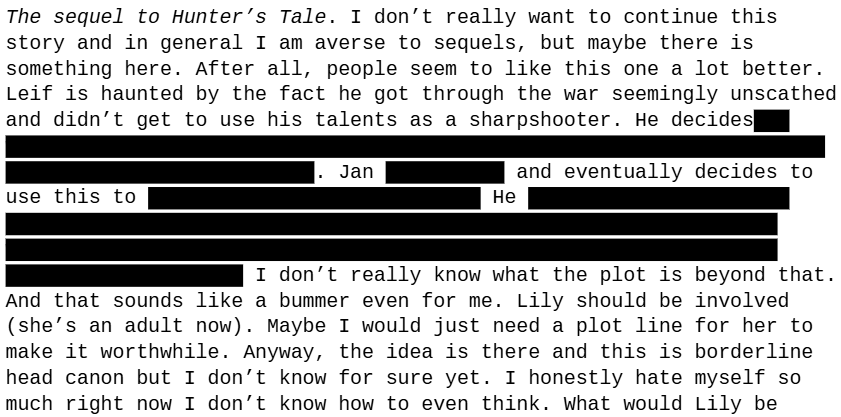
In January of 2024, just a few weeks before I would go to India for the very first time, I went to my favorite coffee shop and wrote out the ideas I had for my next novel in a self-deprecating brainstorm session. About the possibility of a Hunter’s Tale sequel, I wrote:
Moving on.

In the nearly two years since I wrote that, the story has revealed itself to me, but I can’t really identify any of the points along the way where I learned what was going to happen. One moment I was wondering what would happen if Leif went back to Afghanistan and the next I had a neo-Western at the tips of my fingers. I don’t even remember when, why, or how I came up with the title. But here I am with a story that is much bigger and bolder than Tale.

I had some reservations about going back to Leif and Jan. Leif is my least offensive main protagonist and Jan is probably my greatest achievement in character building. Readers love Jan. I wanted to leave them alone, safe and warm together with Lily. And Lily, being a teen in Tale, she could’ve stayed like that with boundless opportunities ahead of her. Instead, I’ve reached out and dragged them back into another story, one that is, I can assure you, much more harrowing than the happy endings I imagine some readers had in mind for them.

I want to get it right. I have to get it right.

And three (please excuse the extended tricolon), I was working on writing this blog post.

I don’t blog anymore, not really. Since my move to Milwaukee, almost all my posts have been reviews of the year in film and existential life updates connected to my travels in India. Once again, after my fourth and fifth trips to the subcontinent, my experiences abroad have helped me think deeply about some aspect of my life. And, quite conveniently, given me a chance to talk some more about other people’s art that means a great deal to me.

So it was important to me to get this blog post written before moving on with Lives We Might Have Lived. This felt like something I “had” to say before I could clear my mind enough to lock in and get through the first draft, which I intend to be by Christmas. It’s just been hard to get to the writing of this post because first I had to rewatch a long movie, reread a normal length book, and make use of the small amount of time I have left when the dishes and laundry are done.

“Taj Mahal is nothing,” said one of my Indian friends. “There are much better places in India. Meenakshi Temple is much more impressive. Jagannath, many others. Taj Mahal, Charminar, these are famous frankly because Muslims have marketed them well.”

“How do you spell that, Meenakshi?” I said, opening my “places to visit in India” note and brushing aside the casual Islamophobia that is unfortunately so common in India.

“And, I don’t know,” I said. “I thought the Taj was pretty amazing.”

“Oh, it’s very good, of course.”

“You just said it was nothing.”

“I may have overstated.”

I think hundreds of years of awestruck visitors is due not so much to Muslim marketing as it is to the fact that, as Yves Saint-Laurent said, “Fashion fades, style is eternal.”

I have seen buildings that are great in ways different from the Taj. Ornate basilicas, hulking stadiums, glorious monuments. But none of them are, well, perfect, as the Taj is perfect. Its form is its function and its function is its form. There is no wasted space, no wasted effort, nothing to “get,” nothing to miss. I wonder if there is a building that more closely approaches timeless, objective beauty.

This is central to one of the best films of 2024, Brady Corbet’s The Brutalist (light spoilers ahead). The film follows Laszlo Toth (Adrien Brody), a Holocaust survivor who comes to the U.S. in the 1950’s for the promise of freedom. In Hungary, he was a renowned architect, but he must start from nothing in the U.S. fashioning uninspired furniture in his cousin’s shop, praying for the day his beloved wife and niece may join him.

Much of the drama comes from the push and pull of artistic vision between Toth and his eventual benefactor, Harrison Van Buren (Guy Pearce), a relationship which is a college seminar on its own. When Toth gets the opportunity to redesign Van Buren’s reading room without his knowing (a misguided surprise gift form his son), Van Buren flies into a rage and berates Toth and his cousin for what they’ve done. Interestingly, it is in response to this tirade that we first see confidence and swagger from Toth, who to this point has been defined by fear, humility, and meekness. He knows what he built is good, even if the person he built it for doesn’t see it the same way, and throughout the film it is only when talking about his art that we see this same swagger.

After Van Buren discovers Toth’s accomplishments in Hungary, he not only apologizes to Toth but invites him to his home and commissions him to build a community center in honor of his late mother. Two of the many examples of the ways in which Van Buren misunderstands Toth’s vision are in this first reception at the Van Buren mansion. Though there are many wealthy, influential people at the party, Toth is the guest of honor, and Van Buren gives him much of his time and attention. At one point as they speak privately over drinks and cigarettes, a guest interrupts to express his admiration of the reading room, making an astute observation about how the design draws the viewer’s attention, which as we will learn is one of Toth’s greatest concerns when designing. Van Buren shows complete disinterest in the man’s comments and rebukes him for interrupting. Then, Van Buren opts instead for a very general question: “Why architecture?”

Watch the scene for yourself:

It’s one of those monologues I will think about for the rest of my life. “Is there a better description of a cube than that of its construction?” To me, Toth’s buildings – like most Brutalist style buildings – are ugly, all the more so because he typically uses concrete. The film even acknowledges this when Leslie asks why they don’t build the community center out of something more aesthetic. But the form of his architecture is remarkable because of its functionality and endurance. Were there more beautiful buildings in wartime Budapest? Of course. Are they still there? Many of them are not. What this means is that a synagogue built by Toth would be from its inception excellent for it’s synagogue-ness, but in its endurance it would maintain the synagogue-ness and take on a political element.

It’s all well-beyond Van Buren, and Guy Pearce’s “what a poetic reply” line reading is quite possibly the greatest moment of his acting career. Missing Toth’s point, Van Buren just moments later will offer Toth a commission that flies in the face of everything Toth just explained.

The singularity of purpose in his architecture makes Toth the absolute wrong architect for Van Buren’s planned community center, an impassioned but Quixotic tribute to his late mother. Van Buren envisions it to be a library, gymnasium, church, and theater. “That is four builds, not one,” says Toth. But Van Buren is adamant Toth must be the one to do it, which again shows his crucial misunderstanding of Toth’s art.

But, short of opportunities, Toth obliges, and the concrete monstrosity is eventually finished, but in the final moments of the film we understand how Toth has insinuated his singular vision into the multivalent blueprint.

The second obvious thing (back to the Taj!) that the Taj has going for it is the material: Marble, Rajasthani marble. Though not as shiny and luxurious as Italian marble, Indian marble is hard, durable, and impermeable, making it resilient through rain, wind, and years, ideal for something like a giant mausoleum meant to stand the test of time. I learned these things from one helluva salesman at a local marble purveyor, and I did walk out of there with a few small beautiful pieces. One of the most incredible traits of marble is that, even in its impermeable forms, it is luminescent (seriously if you have marble try this). The Taj is dazzlingly bright during the day. At night, with the proper lighting, it glows.

Toth’s community center is entirely concrete save for one feature: the altar, which is made of – you guessed it – marble. Though he is Jewish, Toth takes the mandate to build a significantly Christian space seriously, and so he insists on traveling to Italy to source just the right marble for the centerpiece of the build (to you and me, anyway; Toth may see other features as the heart of his work). The time in Italy contains by far the film’s ugliest scene, but also arguably its most beautiful as the local guide shows Toth and Van Buren the way through the marble quarry to the stone he has specially selected. It feels in that quarry that the trio have stepped beyond the circles of the world into another ethereal plane, kept grounded only by the guide’s recounting of anti-fascist resistance in wartime Italy. The marble slab comes to shimmering life with a simple pour of water over its face. It is clear that the marble will be, in true brutalist fashion, a perfect marriage of form and function. A marble altar? It is its own explanation.

The quarry scene also illuminates some aspect of The Brutalist that I think is obscured in the ugliness of concrete, and that is the fundamental awe human beings have for stonework. Though impressive and beautiful in their own ways, I’d argue no building material is as capable of instilling wonder in human beings as stone and stone-like facsimiles (concrete).

Ah, look, a chance to jump onto a Tolkien tangent:

Tolkien loved Creation and the natural world, and his care for everything from the stars above to the depths of the oceans below comes through so overtly in his writing. His greatest love was most probably trees, the domain of the deity (Vala) Yavanna. But he also held a special reverence for rock and stone, the domain of Yavanna’s husband, Aulë . Trees are precious, living things, symbols for growth and renewal. They can be old, of course – very old – but still need nourishment, tending, shepherding. Stone, on the other hand, speaks to a depth of time beyond memory. It is the bones of the earth.

So it is no surprise Tolkien often marks hallowed spaces in his world with stonework. There are the hidden First Age cities of Gondolin (Quenya: Hidden Rock), Menegroth (Sindarin: Thousand Caves), and Nargothrond (Quenya: Fortress on the River Narog). That same Quenya root “ond” shows up in the name Gondor (Land of Stone). And what is the great fortress city of Gondor, Minas Tirith, made from? White stone, akin to the stone the Numenoreans built their great cities out of. I can go on and on – the Stone of Erech, the Halifirien, Khazad-Dum, the Glittering Caves, when Tolkien wants to instill awe, gravitas, ancientry, he uses stone. He never traveled to India, but I am sure if he did he would have been moved by the Taj Mahal.

For all his bluster and superficiality, there are moments where Van Buren demonstrates something close to a genuine appreciation of beauty. In the quarry scene, he stretches his arms across the slab the guide has chosen for them and lightly places his cheek against it. It’s a sort of worshipful supplication in the face of inimitable beauty, an act of complete reverence. I hate to admit that anything Harrison Van Buren does moves me in any way, but I think about this shot often, and it brings me to the next part of this blog and a work of art that is every bit as powerful as The Brutalist.

The quarry from The Brutalist and Peter Jackson’s rendering of Minas Tirith in The Return of the King.

On my first trip to India, I went with one of my world-traveling friends to a bookstore in Bengaluru he had been to before (Blossom Book House). It was every bit as enchanting as he said it was, with stacks upon stacks of books arranged in dubious order, prompting the bibliophile to browse and search and discover. I walked out with a new (2023) hardcover book that caught my eye because it had tigers (my favorite animal) on the cover: Loot, by Tania James, a leading voice in the literary community of the Indian diaspora (and only 599 rupees so less than $7 why are books so expensive in the US??). The blurb was plenty compelling, especially because it was historical fiction featuring Tipu Sultan, a late 18th-Century ruler whose summer palace we had just visited earlier that day.

Loot is now one of my favorite novels of all-time. And because I want you to read it I’ll avoid spoiling it as much as I can!

It is the story of Abbas, a talented young woodworker in Bengaluru who works with a fictional French inventor (Lucien du Leze) to craft a mechanical tiger for Tipu Sultan. This would be about like if George Washington had asked an indentured servant to help remodel Mount Vernon. A bellows within the wooden tiger allows it to grunt and growl as it sinks its teeth into a supine British soldier, and the connected organ allows music to be played through it as well. Tipu’s Tiger (which is a very real historical artifact) is a rousing success, and Lucien offers Abbas an opportunity to return to France and become his apprentice. It’s all going great for Abbas until General Cornwallis (yes, Tom Wilkins in The Patriot) arrives in southern India and finally tames The Tiger of Mysore (Tipu Sultan), and Tipu’s Tiger is hauled away with the other spoils of war. Abbas begins a journey to reunite with Lucien and the Tiger.

Loot is about many things, and many of those things are meaningful to me personally, but most germane to this indulgent essay is the relationship between art, artist, and audience. Abbas is an artist, and nothing he creates makes him feel so fulfilled as working side by side with Lucien on this one-of-a-kind automaton. It is an expression of himself, and a work so great that he wonders if it might stand the test of time and remain long after he’s gone. If not, it is surely the first step in an artist’s journey towards making the thing that will outlast him. In order to continue this journey, he must find the tiger again and retrieve the proof that he crafted it, a small engraving on the inner mechanism that credits the automaton to him and to Lucien.

Abbas succeeds at long last in finding the tiger again, but discovers that while the tiger means one thing to him, it means something completely different but perhaps just as powerful to its current owner. Abbas clearly has much in common with Toth, and the owner of the tiger turns out to have more than a few things in common with Van Buren, though their eye for art feels much more genuine (and there’s an entire essay to be written comparing those two characters).

When Abbas gets a few moments alone with the tiger at long last, the scene is tactile and spiritual in much the same way as Van Buren touching the marble.

Behind each imperfection is a story only he would know, a story interwoven with his own. He has made other things, admired his own creations, but nothing has so altered him, nothing has led him to the thought that dawns on him now: This is all that I am. This is all I have to give.

Is The Hunter’s Tale my Tipu’s Tiger? Or am I still carving mine? Will I fare better than Abbas when the thing I’ve made belongs to someone else and is subject to their interpretation? Should the creation, in the end, matter to me more than the creating?

I have gotten at least one tattoo every place that I’ve lived. At this point, I’ve spent over three months in India, and next time I go I’ll be setting up an Indian bank account and getting an Indian phone number, so it seemed it was time for me to get a tattoo in India, provided it was with a particular Bengaluru artist that had been recommended to me and that it would be on the last day of my visit so I could just wrap it up and fly home and not worry about aftercare in a country that has given me a severe infection before. As it happened, my most recent trip was scheduled to end in Bengaluru. I contacted the shop and got an appointment for a tattoo of Tipu’s Tiger.

And then the day before my appointment, the artist fell ill with a fever and needed to cancel.

I was disappointed, having gotten myself psyched up for something that was, probably, an unnecessary risk but also a ton of fun. So, with a day to myself, I walked to Blossom Book House and browsed around for a while, disappointed not to find Tania James’s The Tusk that Did the Damage but finding a lightly used edition of Arundhati Roy’s The God of Small Things.

Back outside in the heat of the day, not sure what to do with the few hours remaining for me in the country, I realized how badly I wanted to get a tattoo, some kind of tiger tattoo even if it wasn’t Tipu’s Tiger specifically. I had gone too far with this plan, and it had already taken on meaning to me. Every tattoo I have says something about where I was in life when I got it (even the heart-shaped waffle), and this tiger suddenly felt like the perfect symbol for so many things I was feeling. So I looked up tattoo shops in my general part of the city and found one that had many high ratings and was recognized as being sanitary and professional. And wouldn’t you know it was a five minute walk down the same street as the bookstore. Fuck it, I said. Let’s see if they take walk-ins.

For the record, I do not advise getting a walk-in tattoo anywhere, least of all in another country. And I definitely do not advise putting yourself in a situation where you have to change the bandage in an airport bathroom before getting on an international flight. But let me tell you, my brother Infant at Micro Tattoo Studio absolutely fucking crushed it. And one month of healing later, I appear to have escaped any infection.

I understand very well now why the Taj Mahal, The Brutalist, and Loot mean so much to me. I understand why I’m having so much trouble getting the sequel to The Hunter’s Tale written. And I understand why, even faced with the total annihilation of real art, I am holding so desperately to the hope of writing something that will last. In a time of so much uncertainty I must, as an artist, build a fire each morning and begin again.

A few months ago, when I produced a hard cover edition of The Hunter’s Tale, I needed to revise the beginning of Lives We Might Have Lived so it could be included at the back of the book. Mainly, I needed to change all the verb tenses from past tense to match the present tense I had shifted to. This would be a pain to do manually, so I decided I would, for the first time, try using ChatGPT. I asked the program to switch all the verbs from past tense to present tense, and it did so instantly and with perfect accuracy. “Shall I go on?” it asked, having only done about half of what I copied and pasted. I asked it to, and it did.

And then, when I scrolled to the end of Chat’s output, I was horrified to find it had taken the liberty of continuing my story.

I closed the tab, not even bothering to save the work it had done for me, and began manually changing the verb tenses. I felt so intellectually violated, just sick to my stomach with what I had seen cracking a door just a few inches. I’d seen the face of the thing that is coming for me, for you, for us all, a vampiric force invited in by millions of users every day.

As we exited the inner chamber of the Taj, where the Empress and the Emperor are laid to rest and there is no photography allowed, I asked the guide a question I was surprised had not already been answered.

“So who actually designed the Taj Mahal? Who was the architect?”

“The architect?” said the guide. “Ah, hmm. What was his name…”

Forth now, and fear no darkness.

Soli Deo Gloria

Peter

P.S. Fuck you, Ayn Rand.

Going Back and Building Something Beautiful: 2024 in Film

I tend to have a very low opinion of myself.

It’s something I’m working on, and I’m making progress, but it’s part of my personality.

I also believe my taste to be mine and no one else’s, or, put another way, I have a healthy perspective on the possibility what I like is not what other people like and is maybe not – for the aficionados or the hoi polloi – considered “good.”

So, given my low opinion of myself and my self-awareness on my likes and dislikes, I’m generally hesitant to recommend music, fashion, food, interior design, television shows, books, podcasts, paintings, sculptures, furniture, pets, alcohol, cleaning agents, auto parts, [redacted because my grandma reads this], places to live, places to visit, or really anything.

Except movies. I genuinely, unironically believe I have impeccable taste in film.

I know this is a delusion, but it is the one thing – the one thing – where I believe that if I think a film is good it is good and if I think it is bad it is bad and if I think it is okay it is okay. I’m able to acknowledge sometimes that a film is “not for me” and might still be good, and I know that I also love some films that are probably “bad,” but by and large this is the one place where I actually think my opinions are, well, correct.

It’s probably why film is one of the few things that will get me to blog these days, even as I am going through a bit of an existential crisis regarding writing in general (we’ll get through it).

So now, having made it through a really respectable selection of 2024’s films, I return with what has become a bit of an annual tradition for me: my top 10 films of the year, my favorite performances of the year, and my film of the year. “Top” means some combination of best and favorite, which is partly me allowing a little for the ways this film might skew towards my preferences and partly my excuse to include a better variety of films. My favorite performances follows a similar criteria, but is a little less dedicated to giving an exhaustive list. And the film of the year is not necessarily the “best” movie or my “favorite” movie, but is instead an excellent film that best represents the moment in culture and history (this makes better sense when you read my explanation). I’ll close with a few quick notes on the Oscars, and until then I’ll mostly stay away from using them as a launchpad for my thoughts.

Top 10 Films of 2024

Again, since I have impeccable taste, I highly recommend you watch all ten of these.

10. A Complete Unknown – Before James Mangold’s Bob Dylan biopic started rolling in one of the small historic theaters I frequent, my girlfriend said she didn’t really know much about Bob Dylan. As the credits rolled, she said, “I think I know about as much about Bob Dylan now as I did when the movie started.” It’s fair – the movie doesn’t really get inside his head or explore his childhood or dive deep into his relationships. It’s also fair that it’s 20-30 minutes too long and probably features too many songs (or at least too much of each one). So, if you’re not a Bob Dylan fan, this movie might not quite work for you, in the way that many music biopics don’t work for people who don’t already have a connection to the artist. But I am a Bob Dylan fan, and if I embody any American decade it’s probably the 60s, so A Complete Unknown just makes the top ten as my one sentimental pick (I’m clearly not alone though, as it earned a Best Picture nomination). Mangold’s depiction of the historical time and place is engrossing, and the embodiments of the megastars – Dylan, Baez, Guthrie, Seeger, Cash – are extremely effective. While it hits the familiar music biopic notes, the fresh perspective here is that Dylan’s genius is not presented as a divine gift to the masses or a misunderstood cultural provocation, but rather a living thing in constant push and pull with his own artistic milieu and the crowds who flocked to see this young phenomenon.

9. Oddity – I am only just getting my sea legs with the likes of Longlegs and Late Night with the Devil, so take this one with a grain of salt, too, but Oddity was the best horror film of the year. Pulse-pounding, unnerving, twisting and turning, and legitimately frightening, Oddity holds the freakish and paranormal next to the mundane depravity of human beings and challenges notions of what nightmares are really made of, while also turning a compassionate eye to the mentally ill and neurodivergent who are so often cast as the monsters of our scary stories. The atmosphere is absorbing and unrelenting, the script tight and sensible, and the scares diverse and panic-inducing. Prestige horror is in the ascendancy, and I don’t expect that to change anytime soon.

8. Didi – As many have noted, Didi is like if you combined Lady Bird and Mid90s and somehow came away with the best of both (Lady Bird is a better film, but Didi is arguably a more complete picture of adolescence). And that’s…incredible. The three form a definitive triple feature on the experience of growing up a Millennial, and Didi takes extra steps in its depiction of the Asian immigrant experience and the complicated love between siblings. Films about teens and pre-teens are always susceptible to cliches, and often feel like they were made by adults either imagining what childhood was supposed to feel like or telling their own very specific, very unusual experience. Not Didi. This is as universal, as relatable, as painfully familiar as a film about those awkward years can be. Every kid goes through these things, and that is disheartening even as it is so reassuring. Also notable: features one of the funniest scenes of the year when Chris’s Nai Nai rants about how Chris’s behavior will lead to the end of their bloodline as his mother soothes a bruise on his face with a hardboiled egg.

7. Furiosa: A Mad Max Saga – Mad Max: Fury Road is one of the best films – nevermind action films – of the century, and Furiosa is almost as good, erego…it flopped at the box office and garnered not a single Oscar nom. Make it make sense? Furiosa kicks ass, replete with gonzo performances, over-the-top action, astonishing practical effects, and that distinct weirdness of the post-apocalyptic Millerverse. I watched this and Dune 2 on the way to India, and to me there’s no question which film is better (as much as the Dune franchise is a feat in its own right). If you missed this, find it and watch it, even if you haven’t seen Fury Road. It is propulsive, concussive, preposterous entertainment. “Who is that?” “Someone competent and excessively resentful!”

6. Monster – Hirokazu Koreeda is back! One of the best living filmmakers (and one of my personal favorites) has been just a step off his game after the 2018 masterpiece Shoplifters, with the English/French language The Truth and Korean language Broker not quite reaching his usual heights, though both are still good in their own right. But Monster is a true return to form for the master of twisting and turning sentimentality. Koreeda once again explores the biggest issues and questions through the most intimate and basic of relationships, and his juxtaposition of the world as seen through the eyes of children and adults has never been better. The non-linear story builds and builds to a stunning crescendo of a third act. Monster is riveting human drama.

5. Conclave – Occasionally I’ll tune into a important game in a sport I don’t really care about just because I recognize the weight of the thing. I imagine this is why Conclave has been so broadly popular. You don’t have to be Catholic, or love the Catholic Church, or hate the Catholic Church, or really have any opinion on Catholicism or religion in general to recognize the weight of the conversations held among those cloistered in the Vatican. The decision made by 120 men will have massive implications for millions of people and even the course of history. Conclave establishes this importance so efficiently; within minutes this feels like a Cold War spy thriller. These men who under slightly different circumstances may have been lawyers and professors and salesmen and dentists are instead here in these funny robes with funny titles whispering amongst each other about who likes who and who hates who and who is honest and who is good and someway somehow they have to pick the man who is right for one of a handfull of the world’s most important jobs. Director Edward Berger knows his movie has the ingredients, and oh does Conclave cook.

4. I’m Still Here – I’m still here, too, as part of me will forever remain in the theater where I watched the incredible true story of the disappearance of Rubins Paiva in 1970s dictatorship Brazil. 20th Century period pieces – maybe especially those about government oppression – sometimes feel a little too big, a little too insistent on being an Important Film. They stray into being half-assed documentaries or movies about History and Big Ideas rather than the people who lived through them. I’m Still Here is a film about a family, and that doesn’t change after their lives are upended when government agents take their father away, never to return. This is when most movies expand and pick up speed and build to a dramatic conclusion. Not this one. It never loses track of where it is or what it’s about. It’s about these regular people who have to find a way to move forward and reckon with the uncertainty of not knowing their father’s fate. It’s rare for a film about such Big subjects can maintain its compassionate eye on the people at the center of it.

3. Anora – Sean Baker levels up again. Anora, like Baker’s past projects, coats the viewer in a nice uneven layer of grime – sex, drugs, slaps, shouting matches, general disorderly conduct…but once again he is not exploitative or critical or uncaring about his subjects, most of whom are lower class, sex workers, uneducated, foreign, or some combination. So while Anora is intense, laugh-out-loud funny, and anxiety-inducing, it is ultimately so compassionate and aching, a carefully-constructed portrait of the desire – the need – for human connection and the devastation when it turns out to be something other than we wanted. To walk this line so carefully is a man on wire act, and Baker is Philippe Petit. Anora is like if you cooked some cod with the fish boil method and what came out was Michelin-star-quality fish en papillote.

2. Nickel Boys Possibly the most inventive film of the year. The first person POV was, for me, a little distracting and felt like a gimmick for the first ten minutes or so, and I was a little worried I might just be watching Black Tree of Life. And then I sank into it and was absorbed in one of the more enthralling films in recent memory. It is a testament to the depth of the evil of anti-Black racism in the U.S. that even after so many films have been made on the subject, one can feel so fresh and instill such shock. I will think about some of these scenes for the rest of my life. The entire film is beautifully shot and it glides effortlessly through its unconventional storyboard. It also features possibly the biggest twist of the year, and I cried as the credits rolled. Nickel Boys is a revelation.

1. The Brutalist – No doubt about it. Every year since 2016 (except 2021), we’ve had at least one stone cold diamond certified 5 star all-time classic film, and this year it’s Brady Corbet’s staggering American epic. It knows it, too, which can be off-putting, but if you can run like Sha’carri Richardson maybe it’s okay to flex (of course, you may lose the race at the end to the St. Lucian, which very well might happen if Anora takes home the biggest prize). Anyway, it feels a little ridiculous to distill my thoughts on this film into a paragraph when it’s the type of film that could serve as the basis for an entire university seminar. Individual scenes contain as much as entire movies, and there are three and half hours worth of those scenes. Yes, even the scenes of sensuously touching a hard pillar of masculine desire and insecurity. And also the handjob scenes. I will be rewatching this one, and while I will miss the overpowering experience of seeing it in the theater in 70mm, I anticipate picking up on many subtleties I missed the first time. I haven’t really said a lot about what makes the film excellent, have I? Okay, here goes: through a perfect symphony of cinematography, performances, score, set design, and writing, The Brutalist, presents architecture as a form of expression employed by fleeting humans to find some sense of permanence, a reclamation of space and time and memory when all three threaten at times to dissolve us into wisps of smoke like the ones constantly escaping Adrien Brody’s mouth and nose one cigarette at a time. How’s that?

Performances of the Year

In no particular order:

Nicolas Cage and Alicia Witt, Longlegs. I actually think casting Nicolas Cage might have been a mistake, or at the very least Neon may have gone to greater lengths to hide the fact he is playing the titular serial killer. Despite the prosthetics, it can be tough to not, at times, be taken out of the horrifying moments by remembering this is “Not the bees!” guy. And yet…it is utterly chilling. Longlegs is scary, if not quite so much as the incredible ad campaign had us expecting, but his performance is going to live with me and make my eyes snap open while falling asleep from time to time for a good long while. Alicia Witt’s performance is allowed to be more subtle, and in each of her scenes a layer is added to the character through her performance. By the end, the mere look in her eyes is enough to send shivers down my spine.

Kieran Culkin and Jesse Eisenberg, A Real Pain. They are more or less playing themselves and the characters we expect them to play, but I think it’s unfair to criticize someone for playing the same song when they play it so well. Maybe call it the Christoph Waltz rule. The writing in this film is one of its weaker points, but Culkin and Eisenberg inject it with such pathos, and to the script’s credit it gives both performers room to cook.

Timothee Chalamet, A Complete Unknown. By and large, I’m uninterested in performances that are imitations, but goodness gracious Chalamet’s is so good here and he’s impossible to look away from in every scene, his chemistry and his aloofness obvious with all the different scene partners. His singing is a phenomenal reproduction of Dylan’s distinct sound. Shout out to Monica Barbaro (damn) for also absolutely crushing her vocal performances as Joan Baez.

Sakura Ando, Monster. Her performance in Shoplifters is one of the best things I’ve ever seen, and it’s thrilling to have her back in another Koreeda picture. She is a flawless performer and shows new ranges in this film with her moments of rage as a mother frustrated with a school system failing her son.

Ralph Fiennes, Conclave. He’s a perfect point guard. Dude gets his buckets and facilitates the entire offense. The film doesn’t work without him absolutely crushing every single scene.

Everyone in Anora. One of Baker’s greatest strengths is getting relatively or completely unknown performers to hit the high notes and the subtle undertones. Every single actor in this film is unbelievable. It would be easy enough for the Russian and Armenian goons to be whatever stock characters, but each of those guys is pitch perfect in supporting the masterpiece by Mikey Madison, who is asked to do just about everything in this movie. And, not to be crass, but she’s really good in the sex scenes, and I think we’ve seen in recent history that filmmakers have to take sex scenes seriously (looking at you, Christopher Nolan. Looking at you). These are part of physical performances, in much the same way Keanu Reeves deserves credit for the physicality of his John Wick performances.

Glen Powell, Hit Man. I didn’t get it before. And now I do. The guy in Top Gun: Maverick is not a movie star. This guy is.

Ryan Gosling, The Fall Guy. Speaking of movie stars. This is another film that might not quite work without the chemistry the lead has with all his scene partners. He is so charming and funny and at his lowest points so worthy of sympathy. I’m team Gosling, guys. Give me more.

Carolyn Bracken, Oddity. Plays two roles as sisters Dani and Darcy and does so with aplomb. Her performance of Darcy, the blind medium, is inscrutable in the best way, as we and the characters continually ask, “What the fuck is going on here” as she marches forward in her quest for justice for her murdered sister.

Kristen Stewart, Love Lies Bleeding. The star at the middle of one of the year’s grimiest, sexiest thrillers. Pretty wild that the same woman who got nominated for playing Princess Diana can be convincing unclogging toilets, handling firearms, managing a sweaty gym, and chainsmoking. The fact the two stars of the Twilight series are two of our most consistently interesting actors was not on my Bingo card.

Adrien Brody, The Brutalist. What do I need to say? In a film chock full of astounding performances, Brody’s is the best. He’s one of the greatest living actors with three and a half hours to showcase every inch of his abilities (and of other things). Three and a half hour movies don’t usually work unless you are living and breathing every moment with the central character. Yes, we’re allowed to use the phrase tour-de-force on this one.

Fernanda Torres and Selton Mello, I’m Still Here. They are convincing parents first and notable political figures second. It’s one of the keys to the movie; it’s about a family, and it really, truly feels like one. The kids are all excellent and its all held together by Mom and Dad. So nuanced, so earnest, so believable.

The Film of 2024 is…

This was tough. I thought for a while it might be A Complete Unknown, a film about cultural change and the dream of making it big overnight. The Brutalist deserves a long look, given it’s an immigrant story and one that comes in the wake of the Holocaust, which is upsettingly relevant right now. I also considered Emilia Perez, because obviously (not getting into that just yet). I did not get a chance to see Wicked, but as the sort of spiritual successor to Barbie as the “hey things really suck right now what if we have a big colorful movie that makes us feel good” movie I thought it might be a worthy candidate.

But no, the film of 2024 is I’m Still Here.

At the most obvious level, it’s a film about a dictatorship that rips families apart and keeps its citizens in a state of fear and uncertainty, punishing those who speak out against it and advocating for might equals right. That’s the world we’re moving into in the U.S. That’s not a political statement; it’s a fact. We are moving with alarming speed towards some late stage capitalist horror portmanteau of oligarchy and dictatorship. We are deluding ourselves if we think we are so far away from the day that a father, a citizen (it’s already been happening to the undocumented) can be taken from his home by government agents, bidding a hasty farewell to his family before disappearing forever (Elon Musk has recently called for imprisoning journalists, which is one of the biggest red flags there is). Maybe you truly believe the Trump administration will improve the economy and make the world safer for you and get rid of some things you don’t like, like abortion, and let you keep some things you do like, like guns. Even if that is all true, the signs are still so painfully obvious that what this administration and it’s puppeteers want is an unrecognizable America. They’re not trying to hide it. A congressperson has suggested giving Trump a third term. That’s king-me shit. And you fucking know it.

But I’m Still Here is also a profoundly hopeful movie, too. Brazil isn’t a dictatorship anymore, imperfect and turbulent as the nation can be. Eunice Paiva did, eventually, get the answers her family deserved and made a career out of acting on behalf of the families of the disappeared. She went to law school later in life to equip herself for this crucial fight. She didn’t quit. Brazil didn’t go die. They made it through. We need that right now. We really, really need that right now (it’s almost like we can learn from history, gee, who’d have thought).

And there is something more here that speaks to our current moment. We want things to be the way they were, but we misunderstand what that means. Our nostalgia tends to idealize past decades, even though in those past decades women and minorities had much less freedom and many of the world’s problems had not yet been solved through science. But, somehow, rights for trans people, the Paris Agreement, and the World Health Organization somehow represent the fear and doubt of modernity, and the solution is to roll back these things and get back to a time where men ruled with an iron fist and women had three to four children and we kept foreigners out of society and you get the picture. This is a gross misunderstanding of the nostalgic urge, a manipulative framing to get the masses to embrace far right politics rather than getting at the heart of what we really miss, of what we really want back.

We want the simple joys of 70s family life as depicted in I’m Still Here. We want to ride around town with our friends documenting every day life on our film cameras, without police harassing on the grounds of looking for political dissidents. We want to go to the beach and float in the water without the sounds of a military helicopter rushing overhead. We want cold drinks and real food. We want family pictures. We want to send our kids off on bold new adventures. We want to adopt a stray dog and give him a new life. We want to turn our dream homes into a reality.

Vintage is in right now, and all the stuff in I’m Still Here is so cool: the cars, vinyl, cameras, natural cigarettes, on and on. Why do you think vintage is so popular? Is it just because we used to put more care into the things we make? Is it just because we miss the days before planned obsolescence? Are we overwhelmed with choices? Do we feel stuck to our phones? Do we miss what those things represent? Yes, all of that. That’s what we should mean when we yearn for the way things used to be. We don’t need to go back to outdated views on gender and family and race – we need to go back to a simpler, more sincere, more connected time. We miss that.

Of course, there are some old-fashioned beliefs we should take up again, like the collective agreement that Nazis are bad.

I’m Still Here is the film of the year. Watch it.

And finally…

I will watch the Academy Awards, but I no longer care to follow along with the Oscars “race.” I think, in general, the Oscars guide our discussions of film too much, and the discussions are robbed of joy and nuance when we spend months rehashing the same arguments and infecting our more pure opinions with half a mind towards what is going to win and why.

A whole lot of time has been wasted in the backlash, backlash to the backlash, and backlash to the backlash to the backlash surrounding Emilia Perez. I am so very glad I have not spent the last however many months following along with this discourse.

You can think the movie is bad. You don’t have to enjoy a single second of it. You can think that it’s depictions of Mexico and trans people are deeply flawed and even offensive. But I’m not sure I’ve ever heard more people have such a strong opinion about a film without seeing it. I am as guilty as anyone of “Have you seen _____” “No, but I’ve heard it’ really good!” That seems to be the general, totally uninteresting reaction from most people: “No I haven’t seen it but I’ve heard it’s really bad and also offensive.” It might be bad, and it might be offensive, but I dunno man maybe watch it and decide for yourself? Have your own nuanced opinion. I’m going to work on getting better about this, and I encourage everyone to do the same.

But, back to the Oscars, the only reason we’re having this totally uninteresting discussion of Emilia Perez is because it has been very well-received by critics, and the months long Oscars race has kept it in the conversation. While the Oscars can prop up outstanding films that might have otherwise gone more unnoticed, it can also set up lightning rods for bad films, and that’s a real shame. It’s like how the NBA All-Star break has made everyone think the NBA is terrible. The NBA is not terrible. It’s flawed, but not terrible. We been knew the All-Star break is bad. How and why is that a measure for the health of the league?

But, related, there’s been what seems to be a growing polarization between critics and general audiences, at least as far as Rotten Tomatoes suggests. This year more than ever I’ve noticed films rated well by critics that have very low audience scores and vise versa. This is something to keep an eye on. Are bigots flooding RT to tank certain movies, al la Last Jedi (which was also a legitimately bad movie but let’s not get into that here)? Are moviegoers getting dumber? Have moviegoer tastes changed? Have critics gotten more pretentious? I don’t know the answer, but it’s something to pay attention to.

Anyway, point is, I’m trying in general to be more intentional about how much “out there” I absorb, and it has made movie watching so much more enjoyable for me. Will I be pissed off if Emilia Perez wins Best Picture? Maybe a little (don’t worry it’s not going to). But it won’t ruin the year in film for me. I remember the way Green Book winning made me so so mad, but what I remember most now is the fact that 2018 is one of my favorite years ever in film (Roma, Shoplifters, Ash is Purest White, Minding the Gap, and many more). How stupid it would be to ruin a year like that hand-wringing over Green Book and Bohemian Rhapsody.

So watch Emilia Perez. And then don’t let it ruin your life. There’s just too many good films to talk about to spend that much time being outraged about this one.

See you at the theater.

Forth now, and fear no darkness.

Soli Deo Gloria

Peter

Suits

I went to India and brought back a superpowered straightjacket.

One of the things that makes growing up a boy relatively easy compared to growing up a girl is the smaller number of lessons to learn and expectations to meet. I’m pretty sure I was 21 before I learned that every girl knows to take her keys out before she walks to her car, and that one technique is to put four keys between your fingers like Wolverine so you can stab a possible attacker in the eye and incapacitate him.

It’s undeniably harder to grow up a girl. But the overwhelming range of lessons and expectations does also come with certain areas of freedom amid all of the restrictions. For instance – how one dresses. Not necessarily how well or how modestly one dresses (still restricted there!), but what options women potentially have for styling their outfits.

Take, for example, the three most famous players in the 2024 WNBA Draft. Caitlin Clark, Cameron Brink, and Angel Reese each wore very, very different outfits and each looked stunning in their own way. At least as they contend with all the limitations facing women’s sports, they’ll be able to express their unique senses of fashion. A matching white double satin shirt and skirt from Prada, along with a sparkly rhinestone mesh top underneath and black brushed leather slingback pumps? Hell yeah, Caitlin. A black-and-white asymmetrical Balmain gown featuring a thigh-high slit, a bodice cutout, and a rosette appliqué at the shoulder? Mercy, Cameron. A backless Bronx and Banco silver knit dress with a plunging V-neck and hood and coordinating Christian Louboutin pumps? Okay, Angel, Okay!

A few weeks later, the NFL Draft kicked off with three quarterbacks selected, three new faces of the league. The first was Caleb Williams, one of the most “eccentric” prospects in recent years (excuse me while I unroll my eyes from inside my skull). And he wore…

A suit. A navy suit with a double-breasted jacket that featured a zipper fastening instead of buttons.

He was followed up by Jayden Daniels, who wore…a suit. And then Drake Maye. Who also wore a suit.

You grow up as a boy with fewer rules and more freedom. You will not be held to the same impossible range of (sometimes contradictory) standards as your sisters, but what you find out later is that despite your developmental largesse, some paths are chosen for you, and those paths are narrow, and the ground outside them is rocky indeed.

From adolescence into adulthood, there is a small but crucial set of criteria for American boys. Some of them can be helped and others can’t. Some actually make you more attractive to women (and/or men) and others don’t. Most of them are silly. The list is manageable because it’s so short. It’s daunting because it’s so limiting. Beginning with puberty, you want to become one of the taller in the class, grow body hair faster and better, get bigger and stronger, develop an above-average-size penis, and speak with a low voice. You get a little older and you must remain physically virile, prove to be sexually adept, exhibit confidence at all times, land on a stylish haircut and facial hair combo, maintain a good job, and dress professionally.

Quite remarkably, this already narrow scope can be focused onto one simple signifier:

Yeah. The suit.

The suit is the panacea for manliness; with a good suit, you can check all the boxes.

This is something you learn from a young age as a boy. Just one example: I remember watching an episode of Jimmy Neutron where Jimmy wears a suit to the wedding of Jet Fusion and Beautiful Gorgeous, and Cindy – his frenemy – goes absolutely googly-eyed. When a character voiced by Michael Clarke Duncan (RIP) asks “What did we all learn today?” Cindy replies “Clothes make the man!”

Boys grow up knowing there are many things they will be expected to do to remain respected and admired by men and women (and let’s not pretend this is all about straight men wanting to be desirable to women). You learn about deodorant, and undershirts, and manscaping, and beard balm, and aftershave, and scotch, and cigars, and golf, and [redacted because my grandma reads this] – again, a shorter and less onerous list than girls are given. And you learn about suits. You know you will have to wear one because you’ll make good first impressions, command respect, demonstrate your professionalism, and look really hot.

Thing is…suits suck.

I know – I know – that many men feel most comfortable wearing a suit, but they are deluded if they’re telling you they’re comfy. They’re not – especially if you’re wearing a necktie. They’re also hot, sweaty, inconvenient in the bathroom, a task to put on and take off, high maintenance, and expensive. And the real kick in the inseam? It’s tough to look good in one.

That’s not contradictory to the premise that everyone thinks men look great in suits; rather, it is an extension of it. Men who are heavier might still look professional or powerful, but as often as not they might find themselves in an outfit that is either too tight or too baggy, especially if their weight fluctuates, and in the cultural imagination the fat man in a suit is sometimes symbolic for wanton greed or organized crime. Men who are slight can hardly win, because either a fitted suit will draw attention to how thin and bony they are, or they will swim in a suit that is too big for them.

And maybe some will insist that skinny and heavy men do still look good in suits – “you just have to be confident!” As if confidence is something one can simply drum up when they want a promotion or a date. The little black dress (a la Audrey Hepburn in that really good really racist movie) is about the best thing ever, but I would never tell a woman “oh just be confident! You’ll feel good wearing it I promise! It’s all in your head!”

Even when a man does find a suit that fits him right and makes him look good and feel confident, the resulting signifiers are startlingly narrow. What do you project in a suit? Wearing a suit basically says three things: “I am taking this event seriously,” “I am a successful person,” and “Look how hot I am.” There’s only so much room to expand on this: vest and no jacket and you’re a groomsman at a hipster wedding. Switch the tie for a pocket square and you’re a groomsman at a metro wedding. Maybe you can get a little zany with the colors and patterns, but there is very little middle ground between “normal” and “Craig Sager” (RIP). Most variations on color and style either shunt you into a cliché or stereotype (white suits = Miami Vice) or they just double down on the aforementioned signals (for me, an all black suit (pants/shirt/tie/jacket) says “I’m really taking this seriously and I’m really hot”). Really, for the most part, men fall in line with what’s in with suits. Just think of the fads for light brown dress shoes or white soled black dress shoes, or how you could watch the halftime report of a Champions League match on Fox and see four or five sets of sockless ankles.

Conversely, those ankles would be accompanied by the goddess Kate Abdo (who is basically the studio host Andy Murray to the Joker/Rafa/Federer of Rebecca Lowe/Michelle Beadle/Ernie Johnson), who has a plethora of options for expressing herself while looking professional and damn good. Again, think of the W draftees; Caitlin, Cameron, and Angel all expressed a lot about themselves beyond “I am taking this big event seriously and also I am hot.”

And yet, despite its many and obvious limitations, men have bought into the idea that the suit really does give them superpowers. It might not be a coincidence that we call what superheroes wear “suits,” and in almost any Marvel/DC movie the suit channels or augments the hero’s power (or grants it whole cloth!). There is clearly something alluring about the idea of putting on a costume and gaining access to incredible powers, especially if they are an extension of your pre-existing talents and skills. So too is the idea of looking dapper while being a badass – examples abound of this, perhaps with James Bond as the ur-text. The two combine to some degree in John Wick, who wears fantastic-looking suits that also grant him super-powered upgrades (namely, being bulletproof). Well-dressed, skilled in combat, dog lover? John Wick is basically the ideal American man – thank goodness he is played by someone as kind, gentle, and unproblematic as Keanu Reeves.

I’ve been thinking about all this and am now writing about it because I recently acquired a couple nice suits. How and why I got them, how I’ve felt wearing them, and how other people have reacted to them have made me feel a lot of things and given me lots to think about. And, in recent weeks, my body dysmorphia has gotten pretty bad again, and unpacking how I feel about suits might help me in reckoning with why I can’t go get a donut in the break room right now or miss a workout tomorrow. Yeah I’m gonna tell you about India but if you think you can get through a blog post without me oversharing and being an English Major you’re clearly new here.

~~~~~~~~~~~~~~~~~~~~~~~~~~~~~~~~~~~~~~~~~~~~~~~

I’m a developmentally-imbalanced male, and the areas I have most typically been slow in are anything related to the body and physicality. A late bloomer, I guess. So, naturally, I didn’t wear a suit until I was 20 years old.

It was the first suit that was ever “mine” (although I didn’t have to pay for it) and it was for my sister’s wedding. Gray with a white shirt and purple tie. We took some measurements and ordered it and then took it in to be altered so it would fit right. I remember being at the seamstress hating every minute of it. I didn’t want to wear the suit and I didn’t much care how it fit me. My go to style at the time was cargo shorts and Christian rap tees with cross trainers, and I had – for years – avoided wearing dress clothes whenever possible. They made me feel like a dog wearing people clothes.

It was fitting that at that point in my life the suit didn’t fit. I had never been uncomfortable with my physique, opting to distort and hide the slight frame of my body in loose pants and large tees, and trying never to show more skin than necessary – I always wore a t-shirt under my basketball jerseys and shorts to below my knees. I was also just not confident in being an adult man yet. Sure, lots of 20-year-olds don’t know how to tie a tie, but that grew out of my disdain for having to do anything an adult would need to learn – especially if it was a traditionally “male” thing.

So I went to the wedding (which was beautiful) and begrudgingly wore the suit and had someone help me tie the tie and to my surprise people thought I looked great. I had never ever been complimented on my appearance the way I was wearing that suit. Maybe there was something to this suit thing after all?

But when I looked at pictures from the wedding later, I didn’t see myself the same way. Yes, I had successfully hidden my hips and ass and every other contour of my body, but the result was that while the other groomsmen looked like they were wearing suits made for them, I looked like someone draped their suit on me.

I don’t know if I was seeing myself accurately, but at the time it was enough to confirm my mistrust of dress clothes and hide the suit in the closet. A few years later, actually wanting for once to wear a suit for a formal occasion, I got the suit out to see if maybe I had misremembered, but sure enough I still felt like I swam in it. It wasn’t an option, and spending hundreds of dollars on a new suit wasn’t either, especially when most future groomsmen duties promised to come with a pricey rental picked out by someone else. Plus it was looking like I would never have a job where a suit was required. So fuck it – no more suits.

Last year, I went to five weddings. I went to the first in my English adjunct blazer with my girlfriend. The next two I went to newly-single in slacks, button up, and tie, in weather so hot that I wouldn’t have worn a suit even if I had one.

The fourth was the one I was most excited for because it was between two of my good friends whom I love. And it was the one I was most dreading, because I was at the very bottom of my singleness depression and we’re in a beautiful friend group of four couples and me. It was in chilly October, so I put an argyle sweater over a white shirt and a tie with maroon chinos – a look I really, really like.

And then I went to the wedding and every guy there was in a suit. Every. Fucking. One. And most of them – maybe all of them? – had a date, too. I felt like I had missed something. Why didn’t I know that of course you were supposed to wear a suit to something like this? And was that somehow connected to why I was single? Not like oh if I just had a suit I would have a girlfriend but like does my lack of both come from the same flaws in my personality? Perhaps there was something fundamentally lacking in me that could be fixed just by putting on a suit.

When I went to India the first time this year, I didn’t put too much thought into what clothes to pack. Most days at work I wear a polo or quarter zip embroidered with the school’s logo and “Admissions.” So that’s mostly what I packed, and for the first half of the trip my main regret was not packing more casual clothes for the little downtime we were afforded.

Later in the trip, working with a man I’ll call Vik, we had the opportunity to be interviewed by a local Telugu newspaper. Vik asked if I had a suit or blazer to wear. I was a little embarrassed not to, but also confused. Why would I need one? I’m an admissions counselor and dressed like one. I told him I’d bring my English adjunct blazer next time and chalked it up to him being old school (he wears a suit every day).

When I returned to India a few weeks later, I brought my blazer. Vik texted me while I was en route that I should wear it on the first day for another press appearance. As we posed for photos, I felt like I had done exactly what I needed to. Indians love a photo-op. Like I can’t overstate it. Every visit has to have a picture documenting it, and if you wander around a shopping mall you’ll see young people everywhere posing for the ‘gram. So by looking sharp for some pictures and answering some questions, I was doing a great job!

But that wasn’t the case. Vik was happy I brought my blazer, and asked me to wear it to most visits we made, but he asked if I had a proper suit. I told him maybe next time.

A few days later as Vik and I were discussing the itinerary for the following week, he mentioned there would be a number of very important meetings. I told him I’d be sure to wear my blazer. He countered:

“I’m going to buy you a suit.”

Vik is a generous man who wants to take care of his partners. He’s not hurting for money and almost everything in India costs a fraction of what it does here. And yet I was mortified. I tried to refuse, because I hate when people ever spend money on me, but also because I was ashamed that my associate was so disappointed in what I had to wear that he would go so far as to buy me a tailored suit. He insisted it was a gift he wanted to give and wouldn’t take no for an answer.

The city we were in – Vijayawada – is known primarily for rice, temples, extreme heat, and textiles, and Vik took us to one of the more well-known purveyors. A couple women helped us pick out fabric. Vik asked me what color and design I wanted and I was at a bit of a loss. I wanted an all black suit, but the black fabric selections were more charcoal, rather than the jet black the world’s most badass football managers wear on the touchline.

“How about blue, like the one I have?” suggested Vik. “Or maybe gray?”

“Sure, blue or gray might be good.”

The women set out several rolls of blue and gray fabric. I pretended to look at them closely, a little disappointed I wasn’t going to get to look like Diego Simeone or Roy Kent.

The younger woman set out dark blue roll with large but subtle checks. She said it would look really good. Vik was not so sure, and was eyeing up a couple of the gray ones. “But it is your choice. Any one you want – they’re all about the same price.” He told me later that the fabric came from one of the top clothiers in India. “If you say you got a Raymond suit in Vijaywada, people will know what that means.”

We narrowed it down to two of them – one of the grays and the blue one – and Vik told me to choose.

I looked to the younger woman and asked, “Which one do you like?” and without hesitation she pointed at the blue one she had set out. I guess I don’t have to tell you which one I chose.

I was already feeling a lot of emotions as we got in the car to head to the tailor. I was grateful and embarrassed by Vik’s generosity, and I was feeling pretty good about myself because of the way the young woman had said the suit would look good on me. The suit had not even been put together yet, and already you can see how the resulting effect of the suit would be to basically a) make more look more professional and b) look good for women.

It was getting into early evening, and the sweltering city was bustling as usual. The driver dropped us off by a side street. Vik had a particular tailor he liked, but couldn’t quite remember where he was located. In India, it’s common for alike businesses to cluster, so on a single block there might be several tailors. We walked past a number of them, and Vik asked for directions a couple different times.

Finally, he stopped outside a super sketchy-looking alley of sorts between two buildings. “I think this is it,” he said. Then he pointed to a sign hanging from the second story of one of the buildings. “Yes! Here he is.”

He led me down the alley and into a narrow, winding stairwell with all sorts of spots and stains. “I remember the first time coming here I wondered ‘oh dear where have I gone to,'” said Vik.

We found the tailor and an assistant (or maybe just a friend who was hanging out?) in a small room cooled only by a fan and any breeze coming in the open windows. He glanced up now and then to see what was happening in the IPL (cricket) match on the small TV.

A couple days later, we went back to the tailor to pick up the finished suit. It took us less time to find the sketchy alley (“Ah,” said Vik, “the filthy stairs. We are certainly in the right place.”). I tried on the suit and…and I instantly felt incredible.

It was the highest quality, best tailored suit I had ever put on. And it was mine.

Vik approved and we headed out. I overthanked him and told him I’d be sure to wear it at our important meetings coming up in Indore and Hyderabad, many of them meetings with new potential partners. “First impressions do count,” I said.

“Why do you think I got you this?” said Vik.

I laughed at the time (Vik is very funny), and I still was overwhelmed by his generosity, but it reinforced for me the main point why I was given this suit: my clothes were insufficient for my work. And it doesn’t really take most of us long to feel like if our clothes are insufficient that we’re insufficient.

Still, I felt pretty awesome in my new suit, and I wasted no time in sending out pictures of me in it. The affirmative reviews made me feel that much more awesome.

I wore the suit the rest of the week as I took many more meetings with Vik and his delightful associate Soum. It absorbed several liters of my sweat and thankfully did not smell by the end of the week.

And I felt…well, great. My trip was exhausting, but it was very fruitful and mostly enjoyable and I could feel how much I had grown up in the last few years of my life – certainly since the time I wore that oversized gray suit to my sister’s wedding. I felt confident and accomplished.

I thought at first I would write about how those two suits – the one for the wedding and the one for this trip – symbolized my maturation from an awkward boy turning 20 to a more confident and capable man of 30. But in the last few weeks, my feelings on the suit have started to change.

For one, I still think suits suck. They are still uncomfortable and hot and sweaty and high maintenance. I’m in no rush to make wearing one a regular thing.

Two, I still don’t have a suitcase mentality when it comes to work. My role has changed in some significant ways with these trips to India, and I’m embracing that, but the fact is when I’m going to business meetings and making sales pitches and being interviewed by Telugu news outlets, I don’t really feel like myself. I like this job, and foresee myself doing it for a while, but someday I want my work to be more closely associated with my identity again. And in no scenario does that involve me wearing a suit to work every day.

Three, I don’t like that a suit has the potential to so affect the way people see me. As someone who is not confident in their appearance, eschews most masculine stereotypes, and generally lacks professional ambition, it is a little uncomfortable to put on a costume that symbolizes all that I discussed above. It is uncomfortable to get praise for wearing a costume I don’t want to be wearing in the first place, especially when the things I’m being praised for aren’t things I want to rely on. Plus, as someone who checks just about all the privilege boxes, I don’t like that an object gifted to me acts to further those privileges.

And four…the suit stifles my own chosen methods of self-expression. Like I mentioned above, it does not allow me to really make my own fashion choices, but it also covers up all of my tattoos. My tattoos are really important to me. I have a lot and am going to get more and I want people to be able to see them. They make me feel confident and say something about me that is unique. The suit hides them. Sure, so does anything I wear with long pants and long sleeves, but after a recent incident at a box office where I was offered the student (high school student) rate, I’ve seriously considered getting hand tattoos so that even in jeans and a sweater I can signal I’m not a damn teenager. But now, if a suit is something I’m going to be wearing more often, I don’t know that hand tattoos are an option anymore. Most people in suits with hand tattoos are David Beckham or a bad guy in a John Wick movie. I’m obviously not either of those, but maybe there is the risk that even “SOLA FIDE” across my knuckles would detract from the professionalism evinced by the suit.

Maybe my feelings about this suit are also affected by my feelings about the other suit I got in India.

While in Vijayawada, Vik offered to take me on a Sunday morning to major Hindu temple, the Kanaka Durga. I asked him if that was okay since I’m a practicing Christian, and he said it was perfectly fine (almost all Hindu temples are open to all faiths).

“But you will need to wear something different. Did you bring anything besides t-shirts?”

I object to classifying polos as t-shirts but fair enough, Vik.

Vik took me to another clothier where we could buy some traditional Indian “ethnic” garb. I insisted on paying this time. Clothing and apparel is often what I like to get as a souvenir anyway.

Vik helped me pick out two sets. One was a kurta for everyday wear (“You could wear it if you ever go to an Indian event in America”). A long-sleeved-collarless tunic with buttons at the top, and a light and loose pair of white trousers. The other set was for formal occasions and was what I would wear to the temple (“You could marry a nice Indian girl in this”). The top was similar but in purple. The pants were a dhoti, billowing and white in a sort of cross between trousers and a skirt. The outfit was completed with a long white and gold stole.

It was unlike anything I’d put on before, and I felt some of those feelings any of us get when we wear a type of garment for the first time, with the added pressure of not wanting to get it dirty in the dressing room. I looked at myself in the mirror and shrugged because I thought it looked nice but I didn’t know if it looked the way it was supposed to. I stepped out of the dressing room, and instantly Vik, Hari (the driver), and a man I’ll call Mo all lit up. Vik tends to have a neutral expression in our many pics, but in the one we took with me wearing my dhoti he is beaming.

The reaction I got wearing the dhoti was much like the ones I got any time that I did something “Indian.” It would start with a smile that I would try any food they put in front of me, happily-raised eyebrows when I voluntarily ate with my hands, and then a big smile when I expressed how much I enjoyed what I was eating. So too when I would ask a good question about the culture, or when I didn’t hesitate to get in a tuk-tuk, or when I greeted someone with “namaste.”

They also insisted I looked awesome in it, too. “You are looking like…superhero,” said Hari. I couldn’t help but text out pics of me in this, too.

On paper, maybe it seems like the effects of the Western suit and the kurta/dhoti are fairly similar. Both are special/formal attire that cover up my tattoos while earning me respect and admiration. Though the dhoti is more comfortable, it is not practical, and I nearly tripped over it several times.

But I felt very different wearing them. In the suit, I give up parts of me in order to exalt myself. In the dhoti, I give up parts of myself to humble myself. The suit says “You’re lucky I’m here.” The dhoti says “I’m lucky to be here.”

Maybe that’s not the effect for an Indian wearing it, but for me it was a way to signal to those around me that I was treating their culture seriously and with care.

I went to the temple the next morning with Vik, his wife, and another one of our associates and his wife, all of us in our temple best. I was properly attired besides my shoes – I came to India without sandals or slides but you can be sure I didn’t leave without any because when your shoes come on and off as much as they do in India, it’s a real pain to have to sit or hunch over every time. After removing our shoes, we washed our feet and proceed to the gate, tall and colorful and bright in the hot morning sun.

It was fairly busy but not uncommonly so, and most who we met were dressed similarly. Some had shaved their heads, too.

We entered the temple and approached the deity. Depending on the time, day, and temple, supplicants may spend hours or even days waiting to catch a glimpse of the deity (here it was Durga, a powerful goddess), at which time they will say a short prayer – less than 30 seconds! – before moving on. I was moved by this dedication, this commitment to ritual and procedure. I was also conflicted, too, as someone whose religion teaches there are no longer any holier, more effective, more powerful places to pray. I certainly believe God is everywhere – even inside us – but could the physical spaces we’re in help us to pray the right way? In making it possible to physically approach God, are Hindus somewhat paradoxically making God more distant? It also made me think again about how I wish Protestants had more rituals and constructed spaces that made much of the beauty and grandeur of God, as Catholics do.

After leaving the inner sanctum, our small group was allowed to gather before some priests who would confer a special blessing. They sprinkled dry rice on top of our heads, gave us small boxes of sweets and a stole, and then sang and chanted a blessing in unison.

I felt something in that moment. Yes, I was running on empty in the heat of the day, in a country where I don’t speak the language (yet), overstimulated at all times, so any little thing might have set me off, but what I felt was what I can only describe as a mystical experience. These don’t always have an explicit connection to religion – I’ve had them watching Everton and embracing my friends and dancing at concerts and looking at art and [redacted because my grandma reads this]. I felt it sitting there in the temple with these men singing at me. It was brief, but I felt it.

The priests gestured towards me and said something to Vik. He turned to me and smiled.

“You have made them very happy wearing that today.”

~~~~~~~~~~~~~~~~~~~~~~~~~~~~~~~~~~~~~~~~~~~~~~~~~~~~~~~~~~~~~~~~

So now here I am, home with these suits. The Western one is still sitting in the garment bag, and I really hope it dried out in the last hotel otherwise it’s gonna be gross when I take it to the drycleaner (but first I have to figure out how to do that). I don’t know when I’ll wear it again outside of future business meetings in India. Maybe not until the next wedding I go to dateless.

The dhoti will remain unworn until then, too. I will bring it next time I go to India, as I am hoping to visit more sacred places, in particular the Tirupati Balaji temple between Vijayawada and Chennai.

But perhaps I will wear the kurta much sooner. I’m working up the courage and humility visit the gurdwara just south of Milwaukee, and it would be just the thing to wear along with a head covering of some sort. It has occurred to me that perhaps a lone white man in western garb might cause some alarm or at least discomfort after what happened there in 2012. Yes, the kurta will somewhat suppress aspects of my individuality. It will signal that I am a reverential person taking the space seriously. As a non-South Asian Christian it will be in some way like putting on a costume. Maybe I will even look handsome in it.

But while a suit is a walking handshake, a firm hand extended in a greeting that means business, maybe the kurta will be received more like steepled hands and a slight nod. Maybe before I am ever able to speak aloud in greeting it will say, “Namaste: The sacred in me recognizes the sacred in you.”

And maybe, if only for a few moments, I will be more concerned with the Holiness within and less concerned with the decaying temple built around it.

Forth now, and fear no darkness (Namárië, Bernard Hill).

Soli Deo Gloria

Peter

In Continued Pursuit of Myself

“Now let us take our ease here for a little!” said Aragorn. “We will sit on the edge of ruin and talk, as Gandalf says, while he is busy elsewhere. I feel a weariness such as I have seldom felt before.” He wrapped his grey cloak about him, hiding his mail-shirt, and stretched out his long legs. Then he lay back and sent from his lips a thin stream of smoke.
“Look!” said Pippin. “Strider the Ranger has come back!”
“He has never been away,” said Aragorn. “I am Strider and Dúnadan too, and I belong both to Gondor and the North.”
The Lord of the Rings, The Two Towers, “Flotsam and Jetsam”

Is real life actually happening all the time? And can you be the same person through all of it?

I wondered these things, weaving in and out of the noise and lights of a Bengaluru night, sitting very close in a tuk-tuk with people I met just days earlier. We were various levels of buzzed and tipsy, having drank and ate and danced at a Shakespeare-themed brew pub for several hours before heading back to the fancy hotel where we’d get some sleep before enjoying our one real day off on a hectic work trip.

One of my new friends held a phone out the side of the carriage and snapped a selfie.

“Hey, you guys,” said another new friend, one of the Indian members of our cohort, “I am having a FOMO.”

He turned from his perch on the small front seat next to the driver. “Because I want in on this selfie too!” He whipped out his own phone and snapped a selfie of all four of us, our smiles much wider than the spaces our driver slid through between buses and Suzukis and Pulsars.

Bengaluru was about the midway point of my time in India doing recruitment and network-building as part of my job in university admissions: 3 weeks, 7 cities, 30 schools, 4,000 students. A blur of hotels, phenomenal food, introductions, goodbyes, insane traffic, and so, so many people. So much newness and so much learning.

From the time I said “sure, yeah, I’ll go” back in September, the trip was a pretty major source of, or at least nexus for, my anxieties, and I thought of it as being three weeks where I would basically put my life on hold. Of course, as usual, and thank God, the anticipation ended up being the worst part, and it was a great trip. But still I asked myself as I flitted from school to school and city to city if it was all real life and if the person living it was really…well, me.

It’s important to note: while my characteristic use of big words and references to this and that might make it seem like I’m being didactic, this is really me humbly grappling with my own messed up way of processing human thought and emotions. I’m not pretending I’m onto something new, and I don’t know if I have any wisdom to impart. But at the very least, writing this will help me sort out my own soul, and maybe in doing so something, even one thing, will resonate with you. And on a very practical level I’ll get to tell you more about my trip and also foist my artistic sensibilities on you hehe.

So what do I do in “real life”? Well, I work a job in admissions where I process applications and evaluate transcripts and send a lot of emails. I do this job so I can provide myself and my best friend who is a cat with food and shelter and a couple streaming services. I work out just about every day. I hang out with my friends, being extra with costume parties and themed dinners and big chilling with video games and movies and…mood enhancers. I’m in the revision stage of my next novel (coming this year) and have actually started writing a sequel to [redacted] coming maybe 2026? I go to church less than I should and small group as much as I can. I play DND. Oh yeah and I invest in things that cause me pain like Everton Football Club, Christianity, the DNC, and dating apps.

That’s me. That’s what I “do,” that’s my life. And for the first time, I could see myself doing more or less the same things five and ten years down the line (of course it won’t go that way but we’re pretending it will).

You can see why three weeks on the other side of the world with absolutely no one I know doing things I’ve never done before would feel removed from my “real” life. This dissociation was compounded by two things: while most/all of the other counselors make trips like this regularly and work mostly/exclusively with international students (or were Indian themselves), international admissions is only part of my job and international travel is a small and new part of my role; and my experience of India was such a limited, privileged exploration of the country.

The first point: This is not what I do for work. It’s very possible it will become a bigger, more regular part of my job, but for now it felt more like an international admissions ride-along. Everyone else on the tour had so much more international experience than me, and they all know they will have more experiences like this in the future. Many of them have cultivated world traveling as part of their identity, and while I have been to three different countries in the last 9 months, and intend to do more world traveling, I haven’t yet gotten to the point where I have made this a part of me.

The second: Yes, I experienced and learned so much. I went so many places, met so many people, tried so many foods…but I also stayed in four and five star hotels, had professional drivers and valets, stayed mostly in metropolitan areas, and visited top schools. I experienced India, but only a small and convenient piece of it. Very few people ever get to do what I did, and I myself might only get to do something similar a few more times in my life – if at all.

So I wondered, as I flew literally and figuratively around Delhi, Kolkata, Bengaluru, Mumbai, Vijayawada, Visakhapatnam, and Hyderabad, if this was my actual life or a just a very long, very stimulating side quest, a spinoff just barely related to the original.

And, I wondered, is this really me doing all this? When I finally made it home through an absurdist odyssey with a shambolic airline, did I leave some piece of me there in South Asia? Did the intimacies I shared or the impressions I made with new friends and acquaintances count if I never see those people again? If all I said and did over there only comes out here in response to “How was India?”, is that the box it forever sits in?

Obviously this is real life and you’re the one living it, you might say – and so might I. But, for me at least, knowing this is different from really believing this. About a year and a half ago I wrote about something similar in the wake of my grandfather’s death, and I expect a year and half hence I’ll write about this again. India was the latest opportunity for me to explore these ideas and hopefully come closer to mastering them.

As you may know already or could have guessed reading my description of my life, I don’t see myself as a serious man who commands respect. It’s my personality, too. I don’t really know how to receive compliments and I downplay my accomplishments (you will NEVER find “M.A.” in my email signature). I constantly have to correct people that I’m a self-published author and that is not such a special accomplishment.

So it was wild in India to suddenly be seen as a valued guest, a distinguished gentleman, a powerful associate. The service industry in India runs mandalas around that in America, and you can’t take a step in a hotel – especially the more luxurious ones – without someone begging to carry your bag or open your door or get you a masala chai (praise be). This is disorienting for someone who can barely afford to stay in any hotel, let alone a Marriott or ITC. “Oh no, you have mistaken me for the CEO wunderkind of some tech startup. I’m just here because my boss asked me to be.”

Similarly, the schools we visited were all so welcoming and hospitable, giving us food and more (awesome) tea and (passable) coffee, often giving us gifts. Before I presented at a school in Vizag, when I was on the solo leg of my trip, I was introduced by a student who read my accomplishments (lol) and even read my quippy bio on my LinkedIn as if it was a line from the Mahatma. I was flustered. “No, see, I’m just here to tell you about my university and will be presenting approximately none of my own original insights.”

Everyone at the agency I toured with continued to treat me with such respect and generosity. I sat with the man himself on a Radisson balcony overlooking the Bay of Bengal late in the evening, drinking whisky and eating prawns, and had an out of body experience like “what is going on this is some Don Draper shit am I an actual grown man oh no I have no wish to be a grown man.”

I am also, it should not surprise you, exceedingly deferential and polite. Unfortunately, you cannot physically move through the nation of India without being assertive and at times exhibiting behavior that in America would get you called a nasty name. Indian people aren’t jerks; it’s just a necessity in a country of billions of people where everyone is go-go-go that you might have to tell someone to get out of your way.

One way to look at these moments of strained identity is as growth opportunities. And that’s true! Maybe if people treat you well you should tell yourself you deserve it. Maybe you have the right to be a little more assertive and advance your interests, even in something so trivial as getting boarded on an airplane or crossing the street.

But there is also the possibility in situations like this of fracturing our identity, of becoming too externally responsive and motivated. Seeing yourself as others see you can cloud your own understanding of yourself, and make you believe you are either much “better” or much worse than you really are. BIPOC Americans have been contending with this for hundreds of years (see DuBois on double consciousness, for starters), and my rather benign experiences of it make that much more evident to me the effects of this discursive violence.

Situations like this, if not well-managed, can also lead to undue code switching. We all code switch, and thank goodness, but constant and extreme code switching is exhausting at best and self-destructive at worst, especially if the codes we adhere to are in direct opposition to our inner being. Again, this is an everyday challenge for minority populations that people like me are often blind to.

There are plenty of times outside of India that I feel these tensions, but the trip was an intense, compressed experience of it. If what happens in India stays in India, then I could just write it off and move on. But as we’ve established, those weeks in India are my real life, and I am the one who lived it. So what does someone like me need to bear in mind when presented with these situations – how can I learn and grow from these situations, so that in the future – whether in a fever dream of newness or in the mundanity of daily life – I can not just keep my head above water but cut through the swells?

I’d point to a few different sources for guidance and inspiration. I’ll start with Takuan Sōhō’s The Unfettered Mind. Sōhō was a Japanese Zen Buddhist philosopher, living and writing in the late 16th and early 17th centuries. The Unfettered Mind is his treatise applying Zen Buddhism to martial arts. One of the key teachings – and the one that has been most helpful to me in dealing with anxiety and OCD – is to flow through the places where the mind stops, what Sōhō calls the “abiding place.” It “signifies stopping, and stopping means the mind is being detained by some matter, which may be any matter at all.” When in combat (most often he is using the way of the sword for his examples), it is essential to act freely and unencumbered by thoughts, reacting and acting in fluid motions. Constant stopping for thought is a good way to be killed. So too in our minds; constantly stopping to think about everything can be our undoing (trust me).

The idea of this flow state can be found in many philosophies. It reminds me of my rudimentary understanding of chakras. If our chakras – pools of energy – are blocked up with the gunk of life – fear, self-doubt, guilt, grief, etc. – our energy cannot flow, and we become spiritually constipated.

That said, those pools are in need of some examination, which is only possible when the water is clean and calm. Consider my favorite of the Proverbs in the Bible, 20.5: “The purpose of a man’s heart is like pools of deep water, but the man of understanding will draw it out.”

These illustrations from Buddhism, Hinduism/Buddhism, and Judaism/Christianity suggest that we must let our energy, our thoughts, our lives flow, and that when these things flow we become better equipped to do the necessary work of deep self-examination and contemplation. We cannot step into every new setting and be consumed with thoughts of “how am I to act?” and “what are people thinking of me?” and “what does this mean for my life?”

Instead of scrutinizing every single situation, we can let our fluid way of being guide us, just as a samurai must react fluidly to their opponent’s strike instead of stopping in the abiding place. As a Christian, this calls to mind passages like Micah 6.8: “He has shown you, O mortal, what is good. And what does the Lord require of you? To act justly and to love mercy and to walk humbly with your God.” We walk figuratively every day, and there is a posture to take when doing so that will prepare us for whatever might come.

But what about when we extrapolate this to a bigger picture of life? Is walking well as simple as one well-measured step after the other on and on until we die? Depending on how you use that metaphor, sure, maybe it is. But I also think sometimes we need to look up and take stock of where we are. At the risk of too many metaphors, in life’s storms we need to have firm anchors of the soul and maintain a steady course, but I think we also need to be able to see those storms as key moments in our lives that invite us to reconsider some things and possibly make some tough choices and – as a result – changes.

One of the most damaging decisions I’ve made in my life was to hold out hope for a certain relationship to develop over the course of many years (and that is as specific as I will ever be about that). But I don’t believe what I did in the macro was wrong. The mistake I made was letting that dream cloud my perception of so many other things, ranging from my own self-worth to my investment in the actual relationships I had. I do not think I was wrong to sacrifice parts of myself and my life for this thing, but I know the way I did it was – ultimately – destructive for me and for others.

There’s a larger discussion to be had about codependency, but this is not the time. Simply put, I believe with all my heart that we are built with the ability – the gift – to sacrifice ourselves, to give ourselves to causes, to dreams, and, yes, to people.

Maybe it’s silly, but at times in the situation I’m referring to, I thought of myself as Aragorn who spent decades of his life facing many (often lonely) trials in the hopes one day he and Arwen would have Elrond’s blessing to wed. But, even though Aragorn is also an INFJ, I was not being like Aragorn, who at all times and in all places was the same man, applying himself in the same way to the task at hand, and those tasks were various and sundry to say the least! Yes, he did have in mind through it all that one day he would press his claim to the throne of Gondor and marry Arwen, but that didn’t cloud his understanding of who he was wherever in Middle-Earth his errantry took him.

Despite my poor imitation of Aragorn, I can see other examples in Tolkien of characters exhibiting this ability to commit to an overarching goal while remaining present and in a flow state day by day, so much so that it’s worth noting as one of the many themes the legendarium explores. Consider Olórin, whose overall purpose incarnated as Gandalf is to defeat Sauron (only the biggest bad left in Middle-Earth), but yet he still takes the time to learn all he can about the seemingly inconsequential hobbits. He has a different name everywhere he goes, and each people group has their idea of who he is and what he’s supposed to do, but no matter how he might adjust his behavior he stays true to who he is and his purpose (the only of the Istari to do so).

One more text to examine: I’ve seen the one season of Blue Eye Samurai four times now, and I will probably watch it another handful of times before the second season comes out (hopefully that’s not too long!). It’s one of my most favorite things I’ve ever watched, and I spend a lot of time thinking about it, always finding something new to ponder. I’ve also tried to figure out why it is that the show connects so personally with me. Yes, I love it because it is beautiful and really really kicks ass, but I also connect with it on a level that makes it not just entertaining but meaningful.

Mizu is, from beginning to end, focused on her mission: find and destroy the four wicked white men she has sworn to kill, taking vengeance on them for the act that brought Mizu into the world as a monster in the eyes of the Japanese with “pure” blood. She learns along the way that she has become too consumed with the fire of revenge to be effective in her quest. But the problem is not that she has committed her life to the sword and to revenge, it’s that in doing so she has closed herself off to anything but the pure fire of hate and violence, the onryo, the demon. In her conversation with her adoptive father, the swordsmith Eiji (possibly the best scene of the season), Eiji does not tell her that her chosen craft (violence) and mission (revenge) are wrong. Instead, he tells her the way she is pursuing them is wrong. She is not pursuing them like an artist, which is what he taught her to be. “An artist gives all they have to their art – the whole. Your strengths and deficiencies, your loves and your shame. Perhaps the people you collected. Maybe there is a demon in you, but there is also more. If you do not invite the whole, the demon takes two chairs, and your art will suffer” (ugh i love this scene and this show so much).

Though he objects initially to Mizu’s quest, by this point he no longer condemns it, and is even ready to help her forge a new sword. Mizu’s big picture decision to dedicate her life to this seemingly impossible task is her decision to make, and neither Eiji nor Ringo will condemn her for it despite what it demands of her. Her error was in allowing the demon to consume her art. She and her new sword will be reborn in fire, a mix of pure and impure steel as all the best blades are. Her life won’t be all about the end goal of vengeance; it will also be about the people and places that quest takes her to along the way.

Living mindfully while also able to make the complicated, introspective choices is really hard, even with examples both real and fictional, practical and philosophical to learn from. It is an exercise in many spiritual disciplines, one of the most elusive being constancy. It’s here again I turn to Christianity (though examples of constancy can be found elsewhere shoutout Taoism). A central belief is that God is eternal and constant in all three persons of the Trinity. Different Christians will interpret this differently and find their own ways to reconcile the apparent inconsistencies and mysteries regarding the character of God. But the point is that we almost all agree that – in stark contrast to the Greek/Roman gods and many other belief systems – the Christian God is not temperamental and inconsistent. God is who God says God is. God does what God says God will do. What a rock that is to stand on. As we’re battered about by the waves, as we struggle to be who we say or think we are or do what we say we’ll do, there is a God who is constant through everything.

Of course, the character and nature of God can be a little abstract, a little out there. So let me return to India for one final concrete example.

My favorite cultural experience of the trip was a visit to a Sikh temple in Bengaluru. One of our valets was a Sikh, and on the bus ride there he told us about his religion, about which I knew very little. It’s a fascinating religion with a fascinating history, but the main point according to our valet was that Sikhs live to help other people and serve their community – that is their primary act of worship. Our valet has made a career out of helping people, keeping them safe and comfortable as they travel in India and other countries, working tirelessly to keep everyone’s ducks in a row.

One of the ways Sikh community service plays is out is in the physical spaces of the temples. Sikh temples provide shelter, food, and comfort for anyone who comes through their doors.

There were a few rules about the temple: head coverings must be worn; shoes must be removed; no photography inside. All three gave the space a feeling of sacredness, though I wish I could have more pictures to share of the beautiful white building and the understated elegance of the shrine.

After a brief stop in the shrine (think church sanctuary), where we sat with a few dozen Sikhs in prayer and meditation in the presence of their holy text and traditional music, we went to the serving hall, where an entirely volunteer team prepared and served a large delicious meal to scores of visitors (I did not partake. It would have been rude not to clean the plate, and given my GI sensitivity I didn’t want to literally bite off more than I could chew).

It was so moving to be in a sacred space where people pursued not just their own spiritual betterment but the material, physical wellbeing of their neighbors. It was convicting for me as a Christian, because I wish more – no, all – Christian churches were like that. And it put into a whole new horrifying perspective the atrocity committed at the temple in Oak Creek (a 20 minute drive south of Milwaukee) in 2012. I hope to visit there soon.

Sikhs are a minority wherever they go – just 1% of the population of India, where they are most concentrated. They take all kinds of different jobs living all different kinds of places. But they carry with them everywhere the mission to help their neighbor and serve the community. Hundreds of years ago, that meant going to war with the invading Mughals.

Today, it might mean helping a nervous American get his luggage from one city to the next as he has an existential crisis of sorts thousands of miles from home.

Forth now, and fear no darkness.

Soli Deo Gloria

-Peter